
When I first started getting more interested in wine, one of the most frustrating things for me was going into a restaurant and looking at the wine list and, outside of the most famous grapes/regions, not knowing what any of the wines were. To be honest, it was both intimidating and frustrating all at once – wanting to try something new and different but having no idea what I was looking at. And all too often, I would end up “settling” for whatever wine looked the most familiar. Eventually, I got tired of this scenario playing out time after time and decided to educate myself. Or rather . . . to get educated. As educating myself meant I would have to do the work. Instead of me having to find sources and read and study, wouldn’t it be great if someone who had already done all that, shall we say “shared their notes with me”? And that’s when I discovered wine classes!
Wine classes may be the pinnacle of education. Let’s summarize what is involved so you can see why I say that.
- You show up.
- Someone pours you one to many wines
- You taste/drink one to many wines
- Someone who has spent years learning about wine tells you everything you need to know about these wines, without you having to do any research
- There is no test
- If you like any of the wines, you buy them and at the end of the class, have more wine than you came with and know more about wine than before you came.
I’m just saying if high school/college were more like this, I probably would have been more “studious”.
Anyways, I mention all this because I (and my eldest daughter, Selah aka Chumpette #1) recently attended a wine class at what “long-time” readers of this 1-month old blog know is my favorite place, The Wine House. This class was focused on the wines of South America. Outside of Malbecs from Argentina, I was not overly familiar with South American wines, so I was rather excited for this class, led by sommelier Kevin McGuire. Most particularly, I was excited to try wine varieties I had not tried before (as I mentioned here: Tradition vs Variety). And, as you can see from the tasting sheet below, I was not disappointed (though I now realize you don’t know what wines I have tried before so the tasting sheet really doesn’t help you with that now, does it?). But you can trust me, there were some new ones!
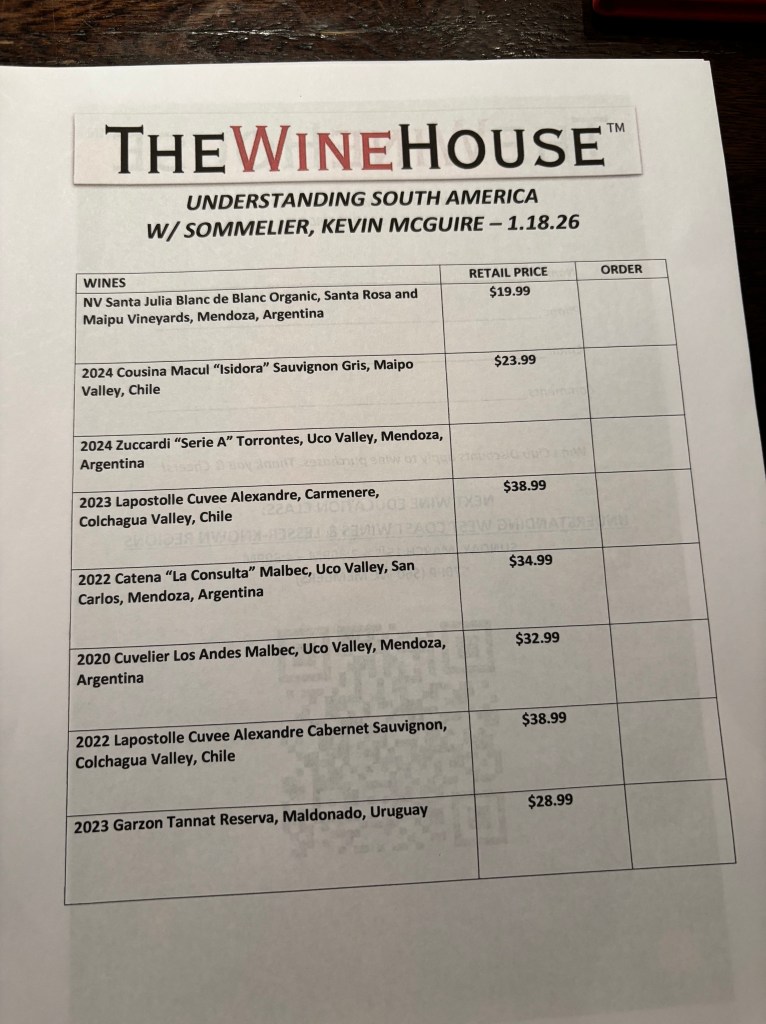
The format of the class is fairly simple. One of the staff (on this day it was Ashleigh) goes around the room and pours the current wine into everyone’s glasses. Once the glasses are filled, Kevin begins our education – and here is where it is a good thing there is no test at the end, as there is a lot of information. Kevin touches on the region the wine is from, the types of soil in that region, the history of the grape varietal, any climate modifiers involved in the area (i.e. mountains, rivers, winds), notes on the producer and more. He will then talk about what you might find in the aroma’s of the wine before moving on to what you can expect on the palette. And he never – and I mean never – finishes talking about a wine without mentioning what types of food it is best paired with. And boy does he know some good food! After he is done making you realize how hungry you are, he gives you a chance to focus on the wine yourself. And, while you are doing that, one of the parts of the class I like the most is he walks around and talks with the guests while they are trying the wines, giving them an opportunity to ask additional questions and let them express what they think about the wine. And then it is on to the next wine!
In this particular class, the wines I was most excited to try were the Sauvignon Gris, the Torrontes and the Carmenere, as they were three varietals that I had not previously tried. I was also eager to try the Tannat in order to compare it to the Virginia Tannats I had tried. I ended up being a big fan of the Sauvignon Gris and Carmenere. The Sauvignon Gris, which is a clonal mutation of Sauvignon Blanc (not a child of Sauv Blanc and Pinot Gris like I expected), had a beautiful aroma with fuller body feel to it, with nice acidity and a hint of pineapple and minerality (per Selah’s notes). The Torrontes was a bit lighter than I think I was expecting and not my favorite. I don’t think it was a bad wine, just not my style. But, as previously mentioned in Tradition vs Variety, I loved the Carmenere. It was a full-bodied wine with ample, soft tannins (helped by the fact they had opened the bottle several hours earlier to let it decant). It had nice dark flavors of blackberries and plum with some spicy, smoky notes as well. Similar to Merlot and yet different enough. In the end, we left with bottles of the Blanc de Blanc, Sauvignon Gris and Carmenere.
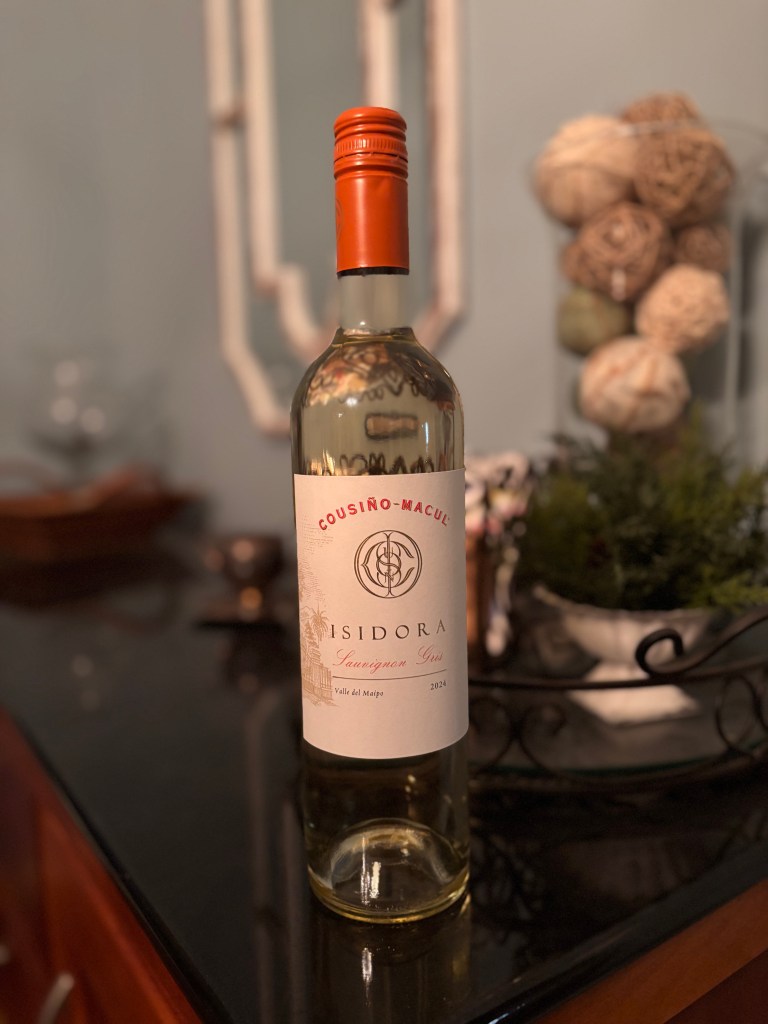
Since I have already recommended the Carmenere, this week’s wine was my other favorite from the class, the Sauvignon Gris, “Isidora”, from Cousino Macul. As previously mentioned, it had a beautiful aroma with nice acidity – I am already looking forward to a beautiful, warm spring day when I can bring this bottle back out. Yes, I know, I can drink white wine during the winter. But a nice spring day will make this bottle even better. If you are looking for something new to try, look no further!
Short story long, for the price of $55, I got to spend 2.5 hours tasting wines I never would have found on my own. And not only tasting them but learning more about them so that next time I am at a restaurant, and I see a wine from South America, I can know what to expect. I never thought I’d say this but – I love studying! So much so I am already looking forward to the next class at the Wine House on “Understanding the West Coast and Lesser Known Wine Regions” in March! But don’t just take my word for it – take a look around and see what “classes” are being offered around you. There are certainly worse ways to spend a Sunday afternoon!
Cheers!
Wine Stat Sheet
| Country: | Chile | Producer | Cousino Macul |
| Region: | Maipo Valley | Grapes | Sauvignon Gris |
| Style: | Dry White | Vintage – 2024 | Price – $20 – $25 |
| Tasting Notes | |||
| Acidity – Medium + Body – Medium/Medium + Tannins – Low Sweetness – Dry Alcohol – 13 % | |||


 Wine Not
Leave a comment